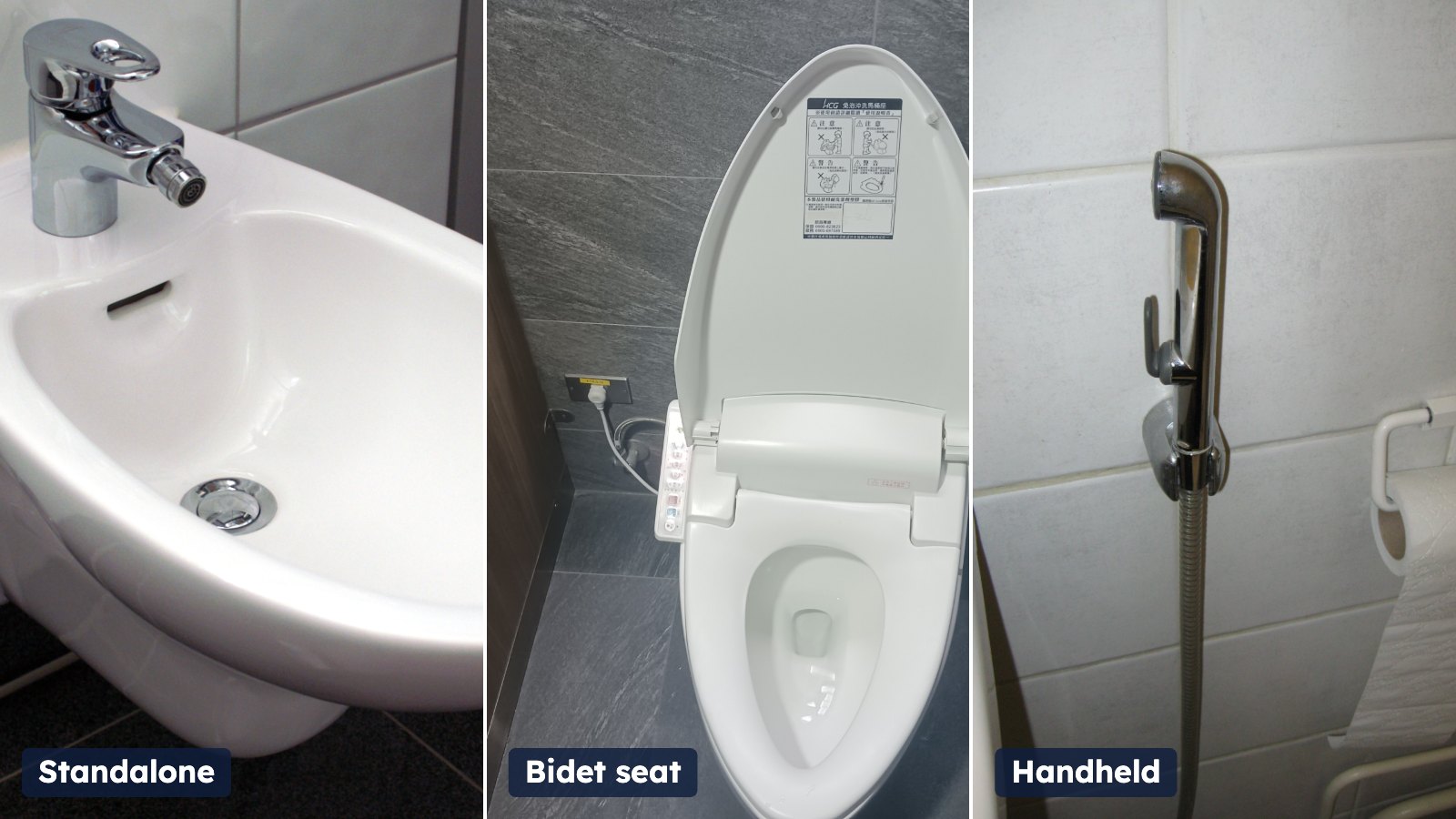
The short version: A bidet is a plumbing fixture or toilet add-on that washes you with a stream of water after you use the toilet, so you clean with water instead of relying on paper alone. In a North American bathroom, it usually takes one of five forms: a standalone basin, an electric bidet seat, a non-electric attachment, a handheld sprayer, or a toilet with the bidet built in. Seats and attachments fit the toilet you already own.
If you have never used a bidet, the category can look more complicated than it is. Every type does the same basic job: it aims clean water at the area you would otherwise wipe, then you dry off.
What changes from one type to the next is where the water comes from, whether it is warmed, whether it needs an electrical outlet, and how much of your bathroom has to change to accommodate it. This guide walks through each of those points so you can tell which kind suits your home before you look at specific models.
On this page
What a Bidet Is
Merriam-Webster defines a bidet as a bathroom fixture used especially for bathing the external genitals and the anal region. The word is French for a small horse, a reference to the way people straddled the original fixture, a low basin on a stand. English dictionaries date the bathroom sense of the word to the mid-1700s, though they disagree on the exact year.
The version most North Americans encounter today is newer. TOTO introduced its WASHLET bidet seat in Japan in 1980, and the company reports selling more than 50 million units worldwide by 2019.
In Japan, the seat is now ordinary household equipment: TOTO cites a 2020 Japanese government figure of 80.2% of households owning one. That shift, from a separate basin to a seat that sits on the toilet, is what made bidets practical for bathrooms that were never designed with one in mind.
The Main Types of Bidet
There are five types worth knowing. Two of them, the bidet seat and the attachment, are the easiest to add because they work with an existing toilet and can be installed without opening a wall.
Standalone Bidet Fixture
This is the traditional European bidet: a separate porcelain basin installed next to the toilet, about the shape of a low sink. It has its own faucet with hot and cold handles, a drain, and often a vertical spray that sends water upward.
You move from the toilet to the bidet to wash. Because it needs its own supply lines, its own drain, and the floor space beside the toilet, it is usually part of a full bathroom renovation rather than a weekend project.
Bidet Seat (Electric Bidet Seat)
A bidet seat replaces your current toilet seat and lid. A wand, usually called the nozzle, extends from under the seat when you press a button and sprays water up toward you.
Electric seats warm the water, either by keeping a small reservoir heated or by heating water as it flows, and most add a heated seat, an adjustable spray, and a warm-air dryer. Controls are on a side panel or a wireless remote.
Some seats are non-electric, which means simpler controls and cold water unless the model connects to a hot water line, but in most conversations “bidet seat” means the electric kind.
Bidet Attachment
An attachment is a thin plate with a nozzle that fits between the toilet bowl and your existing seat. You remove the seat, set the attachment on the bowl, and put the seat back on top.
A dial or lever on the side controls the spray. Attachments are non-electric, so the water is cold unless the model includes a second hose to a nearby sink’s hot water line, which some do.
Handheld Bidet Sprayer
A handheld sprayer looks like a small kitchen sink sprayer on a hose. It connects at the toilet’s water supply and hangs in a holster on the side of the tank or on the wall.
You aim it yourself, which gives full control over placement but asks more of your hand and wrist than a seat or attachment does. The water is unheated unless you add a mixing valve fed from a sink’s hot line, and no electricity is involved.
Integrated Bidet Toilet
An integrated bidet toilet, sometimes sold as a smart toilet, is a complete toilet with the bidet functions built into the fixture. The washing features resemble a high-end bidet seat, and some models add automatic flushing or a lid that opens on its own. It replaces your whole toilet, so it suits a remodel or a toilet that is due for replacement anyway.
The Types Compared at a Glance
The table below summarizes the practical differences. Prices are typical unit prices before installation and match the ranges in our cost guide; individual models can sit above or below them.
| Type | What it is | Needs an outlet | Warm water | Typical price | Install |
|---|---|---|---|---|---|
| Standalone fixture | Separate basin beside the toilet | No | Yes, from the home’s hot supply | $250 to $800 | Plumber; new supply lines and drain |
| Electric bidet seat | Replaces your toilet seat | Yes | Yes, heated in the seat | $200 to $600 | DIY in most homes; T-valve at the tank |
| Attachment | Plate that sits under your current seat | No | Only on models with a sink hookup | $30 to $100 | DIY; T-valve at the tank |
| Handheld sprayer | Sprayer on a hose with a holster | No | Only with an add-on mixing valve | About $45 to $90 for brand-name models | DIY; T-valve at the tank |
| Integrated bidet toilet | Whole toilet with bidet built in | Yes, on many models | Yes, on many models | $500 to $1,500 entry level; premium models far more | Toilet replacement; often a plumber |
How Each Type Connects to Water and Power
Seats, attachments, and handheld sprayers all draw water the same way. A small fitting called a T-valve goes between the shutoff valve on the wall and the fill valve at the bottom of the toilet tank.
One branch of the T keeps filling the tank; the other feeds the bidet. Installation manuals ask for a cold, drinking-quality supply, and one Kohler bidet seat manual specifies water pressure between 20 and 80 psi, which covers ordinary household plumbing. Nothing about the toilet’s drain changes.
Power
Electric seats and many integrated toilets also need power. The same Kohler manual calls for a grounded 120-volt outlet on a dedicated GFCI-protected circuit within 32 inches of the toilet, and our reviewed seats have cords of about 3.5 to 4 feet.
Many bathrooms do not have an outlet that close to the toilet, which can surprise first-time buyers. Our guide to bidet electrical outlet requirements covers what counts as a suitable outlet and when an extension cord is or is not acceptable.
Warm Water
Warm water arrives in one of three ways. Electric seats heat it themselves, using a tank, an on-demand heater, or a mix of both. Some attachments run a hose to the hot water line under a nearby sink; Tushy, for one, requires the sink to be within about 6 feet of the toilet for this. Standalone fixtures are plumbed to the home’s hot and cold supply like any sink.
What Using One Is Like
With a seat or an attachment, you use the toilet as usual and stay seated. You then press the rear wash button, or turn the dial to the rear setting, and the nozzle extends and begins spraying. Most seats also have a front wash, which TOTO describes as using large, soft drops for intimate cleansing.
Start with the lowest pressure and raise it until it feels right; electric seats let you adjust pressure, nozzle position, and water temperature from the remote, and some save those choices as user presets so each person in the household can return to their settings with one button.
If the spray is not landing where you want, you can shift your position slightly or move the nozzle forward or back with the controls. When you are finished, press stop. Then dry off, either with a little toilet paper patted rather than wiped, or with the seat’s warm-air dryer if it has one. Many owners combine the two, running the dryer briefly and finishing with a little paper.
A handheld sprayer works differently. You open the T-valve, hold the sprayer, aim it from behind or in front, and squeeze the trigger. Afterward, return it to its holster and close the T-valve, because pressure left in the hose can cause leaks. A standalone fixture means moving from the toilet to the basin, sitting astride it, and adjusting the faucet the way you would at a sink.
Nozzle Hygiene and Cleaning
A reasonable first question is whether the nozzle stays clean. On most seats and many attachments, it does a good part of the work itself. TOTO states that the WASHLET wand is cleaned before and after every use, and Tushy says the nozzle on its Spa attachment rinses before and after each use and retracts when turned off.
Self-rinsing does not replace occasional cleaning. Many electric seats have a nozzle-clean setting that extends the wand so you can wipe it, and your manual will say which cleaners are safe for the plastics.
Some higher-end seats also mist the bowl to keep it cleaner between scrubbings; TOTO calls this feature EWATER+. Handheld sprayers have no self-cleaning function, so the spray head and hose need a wipe as part of normal bathroom cleaning.
Common Worries
Most hesitation about bidets comes down to a handful of practical questions. Here are the ones we hear most often.
Is It Messy, and Does Water Get Everywhere?
With a seat or an attachment, the spray is aimed upward from inside the bowl while you are seated, so the water falls back into the toilet. Problems usually come from turning the pressure up too far on the first try or pressing the button while standing. A handheld sprayer is the type most likely to drip on the floor or seat, since aiming is up to you.
Will It Fit My Toilet?
Most standard two-piece toilets accept a seat or an attachment, but the bowl shape (round or elongated), the bolt spacing, and the shape of the tank and bowl all matter, and some one-piece and skirted toilets need a closer look. Our bidet toilet compatibility guide walks through the measurements to take before you buy.
Do I Need an Outlet?
Only for an electric seat or many integrated toilets. Attachments and handheld sprayers run on household water pressure alone. If warm water and a heated seat matter to you but there is no outlet near the toilet, an electrician can usually add one, and that cost belongs in your budget.
Is the Water Clean?
Yes. The water comes from the same cold supply line that fills the toilet tank, split off by the T-valve before it reaches the tank. It does not come from the tank or the bowl. It is the same water that runs from your bathroom sink’s cold tap.
The exception is a building that feeds its toilets with recycled water, which TOTO’s C5 manual rules out, so check first if you live in one.
Will I Still Need Toilet Paper?
Most likely, but less of it. Owners describe using paper mainly to pat dry rather than to clean, and a seat with a warm-air dryer reduces the need further. How much you save depends on your habits and on whether your seat has a dryer, so it is better to expect a noticeable drop than a fixed percentage.
What Each Type Costs
Attachments typically cost $30 to $100, with warm-water models toward the top of that range or above it, up to about $150, and most owners install them themselves. Brand-name handheld sprayers are in a similar bracket; Brondell’s CleanSpa sprayers list at about $50 to $90.
Electric bidet seats usually run $200 to $600, plus $130 to $350 if an electrician has to add an outlet. Entry-level integrated bidet toilets cost $500 to $1,500 for the unit, or roughly $650 to $2,100 installed. A standalone fixture runs $250 to $800 for the basin, but new plumbing brings the installed total to about $700 to $2,600.
Running costs are small. An electric seat in a four-person home uses roughly $25 to $50 of electricity a year, and the water each wash uses is negligible on a household bill. For the full breakdown (including labor rates and how to estimate your paper savings), see how much a bidet costs.
Where to Go Next
For most readers, the real decision is between an attachment and an electric seat. An attachment is inexpensive and needs no outlet; a seat adds warm water, a heated seat, a dryer, and a remote that can be easier to reach than a lever at the side of the bowl.
Our guide to bidet attachments versus seats sets out that choice in detail. Before you order anything, confirm the fit with the compatibility guide.
If you are leaning toward an electric seat, these seats are a good place to start.
The Brondell Swash 1400 heats on demand, so warm water does not run out, and has an Auto button for a wash and then a dry cycle. The Bio Bidet BB-2000 Bliss pairs hybrid water heating with a three-year warranty. The TOTO Washlet S2 costs less and also heats on demand, but it uses a side panel, not a remote. The TOTO Washlet S5 adds a remote.
Image credits, cropped and placed side by side: standalone photo by Basan1980 at German Wikipedia, Wikimedia Commons, public domain; bidet seat photo by Saimmx, Wikimedia Commons, CC0; handheld photo by SeppVei, Wikimedia Commons, public domain.