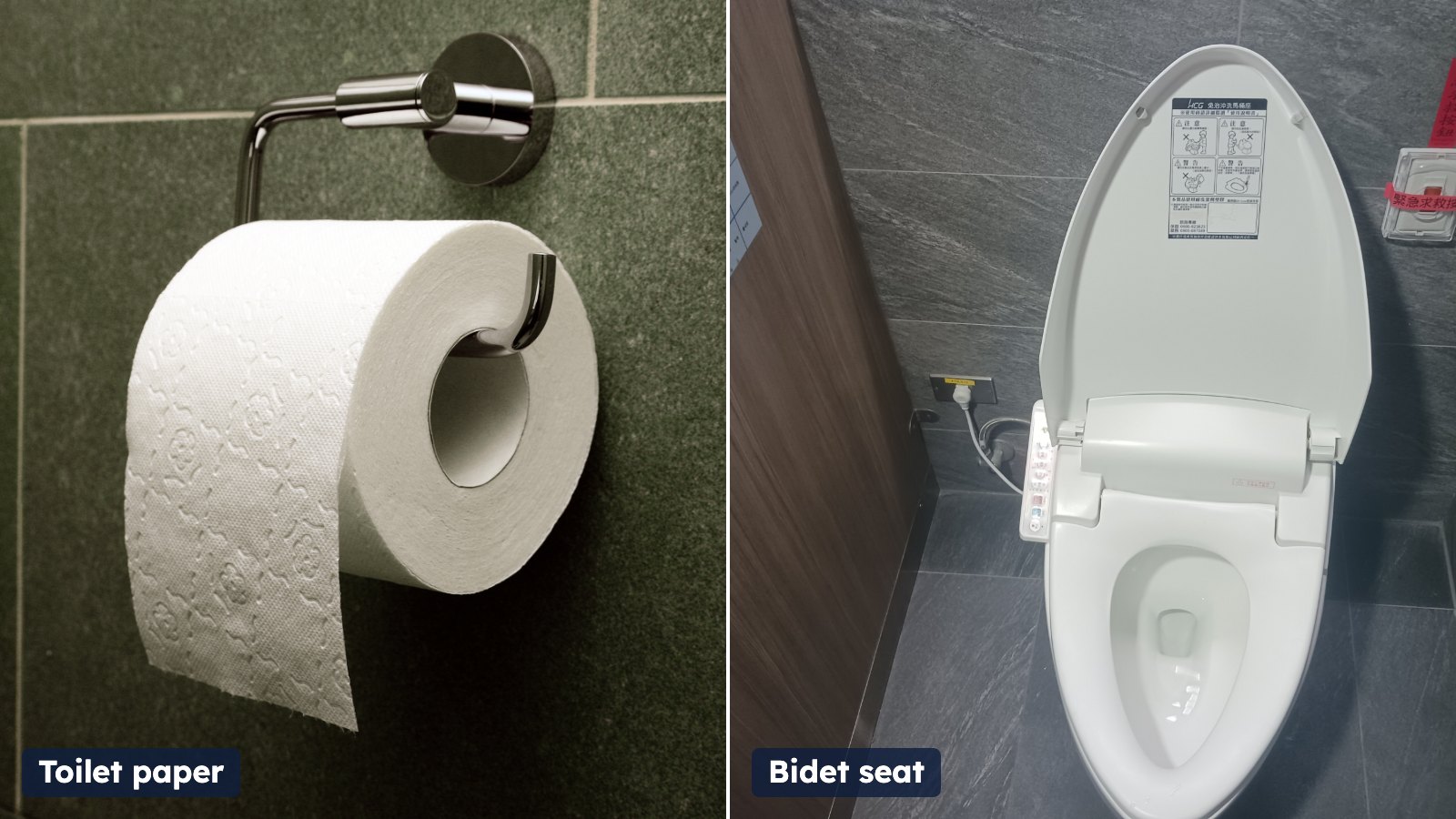
The short version: A bidet wash uses about 16 to 20 ounces of water, according to Brondell and TOTO, and it cuts the paper you buy rather than eliminating it. In our worked example, a two-person household spending $120 a year on toilet paper recovers the cost of a $60 attachment in about 10 months and a $400 electric seat in about 7.7 years. Owners often report feeling cleaner; anything medical is for your doctor.
The bidet versus toilet paper question usually starts with money and ends with comfort. Will a bidet pay for itself, does washing leave you cleaner than wiping, and is it better for the environment once you count the water and electricity it uses? This page works through each of those with figures you can check and assumptions you can swap for your own, so you can judge the numbers for your household rather than take a sales claim on trust.
On this page
How Much Toilet Paper a Household Uses
The most reliable usage figure is by weight. A 2019 report from the Natural Resources Defense Council puts US toilet paper use at 9.2 billion pounds a year, or about 28 pounds per person, and describes a typical four-person household as going through more than 100 pounds annually. The same report says Americans, just over 4 percent of the world’s population, account for about 20 percent of global tissue consumption.
You will often see this converted to 141 rolls per person a year. That number comes from market research that assumed each roll weighs about 90 grams. Rolls vary a great deal in size and weight, and critics who recalculated with heavier rolls arrived at closer to 56 a year. Roll counts are a shaky basis for a budget, so the calculation below starts from what you spend instead.
Spending figures are similarly loose. Consumer spending data compiled by Statista put the average US household’s 2024 spending on toilet tissue, paper towels and napkins at about $131, but that total combines all three products. TOTO cites a range of $60 to $90 a year per person on toilet paper alone. Your own receipts for a few months will tell you more than either figure.
Cost Over 1, 5 and 10 Years
The table compares three options for the same household: keep using paper only, add a non-electric attachment, or install an electric bidet seat. Each figure is the total spent by the end of that year, including the purchase price. The assumptions are set out underneath so you can change any of them.
| Option | Upfront cost | Yearly running cost | After 1 year | After 5 years | After 10 years |
|---|---|---|---|---|---|
| Toilet paper only | $0 | $120 paper | $120 | $600 | $1,200 |
| Non-electric attachment | $60 | $48 paper | $108 | $300 | $540 |
| Electric bidet seat (outlet already in place) | $400 | $48 paper plus $20 electricity | $468 | $740 | $1,080 |
The Assumptions Behind the Table
The household has two people spending $120 a year on toilet paper, which is $60 each, the low end of the range TOTO cites. With a bidet, we assume paper spending falls by 60 percent, to $48 a year, because owners still use some paper to pat dry. That 60 percent is the estimate our bidet cost guide uses, sitting within the 50 to 75 percent reduction owners commonly describe. It is an estimate, not a measured average.
The attachment costs $60 and the electric seat $400, both inside the typical US retail ranges in the cost guide, and both are installed by the owner. The seat adds about $20 a year in electricity. Water for the wash itself is left out because the amount is small on a household bill, as explained below. Prices are held flat, and no repairs or replacements are included.
Payback Period Worked Out
Payback is the purchase price divided by what you save each year. With the attachment, the household saves $72 a year on paper ($120 minus $48), so $60 divided by $72 gives about 0.83 years, roughly 10 months. With the electric seat, the $72 paper saving shrinks to $52 once $20 of electricity is subtracted, and $400 divided by $52 gives about 7.7 years.
Household size changes the answer quickly. Double the paper spending to $240 a year, which is closer to a family of four, and the seat saves $144 on paper, or $124 after electricity, for a payback of about 3.2 years. The attachment pays for itself in about five months.
A single person spending $60 a year would wait about 25 years for a $400 seat to pay back, so for one person the seat is a comfort purchase rather than a saving.
An outlet changes the seat math as well. If an electrician has to add one near the toilet, the cost guide puts that at $130 to $350, which in the two-person example stretches payback to roughly 10 to 14 years. Our page on bidet electrical outlet requirements explains what you need.
The seat also has to last long enough to pay back: of the seats we review, the TOTO Washlet C5 carries a one-year limited warranty and the Bio Bidet BB-2000 a three-year warranty.
Cleanliness: Washing Versus Wiping
The basic difference is mechanical. Paper removes residue by friction, and how well it works depends on how many passes you make and how thoroughly you can reach. A bidet rinses the area with a stream of water, so cleaning relies on the water rather than on rubbing. Most owners describe the result as feeling cleaner, much as rinsing your hands under a tap feels different from wiping them on a dry towel.
Many owners also say their skin feels less irritated once they stop wiping repeatedly, and some buy a bidet for that reason. That is something people report, not a medical finding we can offer you. If you have hemorrhoids, a skin condition, recent surgery or any other health concern, ask your doctor whether washing is suitable and what water pressure and temperature to use.
For people with limited reach or grip, the difference is also about logistics. Wiping requires twisting and reaching behind, while a seat with a remote lets you start a wash with a button. Our guide to bidets for limited mobility covers which features help with reach, grip and bending, and an occupational therapist can advise on what suits a particular person.
Comfort and Day-to-Day Practicalities
The first-week experience depends a lot on which type you choose. An attachment sprays cold water unless the model has a hookup to a nearby sink’s hot line, which some people find bracing at first. An electric seat warms the water and usually the seat as well. How long the warm water lasts depends on whether the seat uses a reservoir or heats on demand, which our page on bidet water temperature explains.
You Will Still Need Some Paper
After washing, you are wet, and most owners pat dry with a few squares of paper. That is why the cost example assumes a 60 percent reduction rather than 100 percent. A seat with a warm-air dryer can reduce paper further, though many owners run the dryer briefly and finish with a little paper. Whether a dryer is worth paying for is covered in our page on bidet warm-air dryers. Some households keep a dedicated cloth towel instead.
Septic Systems
A bidet sends a small amount of clean water into the bowl and reduces the paper going down the drain. The EPA’s septic guidance says to flush nothing besides human waste and toilet paper, warns against wipes even when labeled flushable, and notes that efficient water use helps a septic system work properly.
A wash of 16 to 20 ounces is small next to the 1.6 gallons or less that the EPA says a newer toilet uses per flush. If you have concerns about your system, ask your septic service provider.
Guests and Other Household Members
A bidet seat or attachment does not get in the way of anyone who prefers paper. The toilet works as usual, and the spray only runs when someone presses a button or turns a dial. Keep a roll stocked for guests, and set the default pressure low so nobody is surprised by a strong spray. On electric seats, user presets let each regular user return to their own settings with one press.
Environmental Footprint
On the bidet side, the footprint is the water for each wash, electricity for heated seats, and the materials in the product itself. Brondell puts an average wash at about 16 ounces, roughly one-eighth of a gallon, and TOTO says its WASHLET seats use less than 20 ounces per use. A two-person household washing twice a day each would use about half a gallon daily, or roughly 180 gallons a year.
On the paper side, the costs come from manufacturing. The NRDC report found that major US brands, including Charmin, Cottonelle and Angel Soft, are made entirely from virgin fiber. It says producing virgin wood pulp uses almost twice as much water as making tissue from recycled material, and that recycled tissue produces about one-third of the greenhouse gas emissions of virgin-fiber tissue.
You may see confident figures for the water or trees behind a single roll. Published estimates of the water behind toilet paper range from about six gallons for a double roll to 37 gallons for a single roll, and widely repeated tree counts often appear without a traceable source. Because those numbers disagree so widely, we leave them out.
What is safe to say is that a bidet reduces paper rather than replacing it, so the environmental gain scales with how much paper you stop buying.
If footprint is your main reason for switching, two choices matter most. A non-electric attachment avoids the electricity a heated seat uses, and switching the paper you still buy to a recycled-content brand addresses the fiber question directly.
Which Makes Sense for Your Home
If cost is the main goal, a non-electric attachment pays for itself within months in most multi-person households, and our guide on how to install a bidet attachment shows it is usually a short DIY job. An electric seat pays back slowly in a small household, and faster in a large one, but most people choose it for warm water, a heated seat, a dryer and a remote that can be easier to use than a lever beside the bowl.
Our comparison of bidet attachments and seats sets out that choice feature by feature. Before you buy either, run the payback arithmetic with your own paper spending, and price an outlet if you need one. Those two numbers decide most of the cost question.
Image credits, cropped and placed side by side: toilet paper photo by Elya, Wikimedia Commons, CC BY-SA 3.0; bidet seat photo by Saimmx, Wikimedia Commons, CC0.