The short version: A weak bidet spray is most often a low pressure setting, a shutoff valve that is not fully open, or a clogged inlet filter, and all three are quick to check. If they are fine, test your household pressure against your seat’s range. Ranges vary: Brondell lists 14.5 to 100 psi for the Swash 1400, and TOTO lists a 7.25 psi minimum (flowing) for the Washlet C5.
When a bidet that used to feel firm starts to feel weak, or a new one never seems to get going, the cause is almost always somewhere between the wall valve and the nozzle. This guide works through those points in order, quickest first. Examples come from the owner’s manuals and support pages for the TOTO Washlet C5, Brondell Swash 1400 and Bio Bidet BB-2000, plus non-electric attachments from Brondell, Luxe Bidet and Kohler.
On this page
- Check the Pressure and Position Settings First
- A Shutoff Valve or T-Valve Knob Not Fully Open
- A Clogged Inlet Filter
- A Kinked, Pinched or Stretched Hose
- Is Your Household Pressure the Problem?
- Hard Water Scale in the Nozzle
- Tankless Seats in Cold Weather or on Low Voltage
- Non-Electric Attachments and a Shared Line
- Symptom, Likely Cause and Fix
- Some Seats Are Simply Gentler
- When the Seat Itself Is Faulty
Check the Pressure and Position Settings First
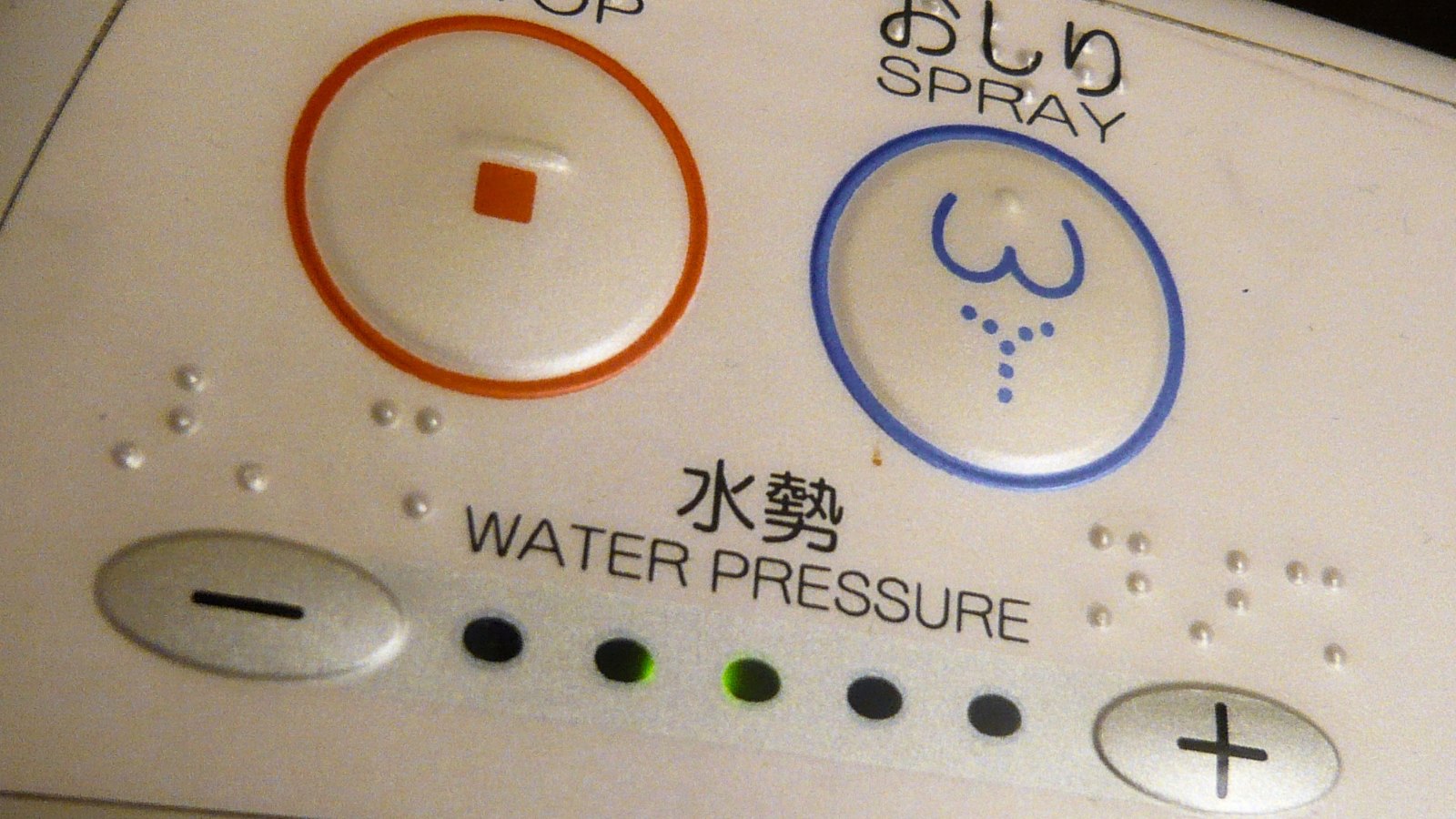
Start at the remote. Every seat here lets you choose spray strength, and a setting changed by another household member, or reset after new remote batteries, can leave you on the lowest level. The Swash 1400 has three pressure levels (Low, Med and High), while the Washlet C5 and the BB-2000 each have five. Bio Bidet’s own troubleshooting answer to “the water pressure is weak” is to check whether the level is set to Low.
Spray pattern and nozzle position matter too. Brondell lists the wide spray setting among the causes of low spray pressure on the Swash 1400, since a wider pattern spreads the same water over a larger area. A spray landing slightly off target can also feel weaker than it is. The Swash 1400 has seven positions per nozzle and the C5 has five, so try a few before deciding the pressure is low.
If small buttons make this hard to check, a remote with labeled buttons and saved user presets makes it easier to return to a known setting. The Swash 1400 and the C5 each store two user presets; the BB-2000 has none.
A Shutoff Valve or T-Valve Knob Not Fully Open
The shutoff valve on the wall behind the toilet feeds both the tank and the bidet. If it was closed during installation or cleaning and reopened only partway, the seat gets less water. Brondell, TOTO and Bio Bidet all name a closed or partly closed valve in their weak-spray or no-water troubleshooting, and Brondell’s fix for the Swash 1400 is to check that the valve “is fully open.”
Turn the valve counterclockwise until it stops. Some older valves are push-pull rather than turn-style. If your T-valve has its own small shutoff knob on the side, open that fully as well. Luxe Bidet, for one, sells a shut-off version of its T-adapter alongside the standard one without a knob. A valve that is stiff, weeps or will not open fully is worth replacing, and our guide to a leaking bidet T-valve covers the fittings at that joint.
A Clogged Inlet Filter
Electric seats have a small mesh filter or strainer where the water enters, and it catches sediment from the pipes. A clog is one of the most common reasons spray slowly weakens over months. Bio Bidet’s BB-2000 manual says the seat “will not operate properly if the strainer is clogged.” Brondell recommends checking the Swash 1400 filter at least once a year, and TOTO calls its version on the C5 the water filter drain valve.
Follow your own manual, since steps differ by brand. The general pattern is to unplug the seat, close the shutoff valve, release the pressure in the line, then remove and rinse the filter with a soft brush. TOTO has you extend the wand to release pressure first and warns never to remove the filter while the valve is open. On the Swash 1400 the filter sits in the water inlet, and Brondell suggests tweezers or needle-nose pliers.
Reinstall the filter fully before you reopen the water, since Brondell notes that a filter not seated properly can leak. Then open the valve slowly and check for drips. This job involves kneeling and fine finger work behind the toilet, so it is reasonable to hand it to whoever did the seat installation.
If you have an external inline filter on the supply hose, check that too. Brondell lists an external bidet filter among the causes of low spray and says to replace it if needed. It suggests changing that filter every six months, and Bio Bidet suggests every three months for its own.
A Kinked, Pinched or Stretched Hose
The supply hose runs in a tight space behind the toilet, and it can be bent sharply or pinched when the seat is pushed back or the toilet is cleaned. Luxe Bidet’s own pressure troubleshooting includes checking that the cold water hose is not kinked or pinched behind the toilet. Look along its full length with a flashlight.
A hose that is far longer than needed tends to coil and kink, and one that is too short gets pulled taut against its fittings. Either way, a hose sized to the run with a gentle curve is the goal. If yours has a crease that will not straighten, replace it with the manufacturer’s part rather than a generic one.
Is Your Household Pressure the Problem?
A seat can only work with the water pressure your home supplies. Manufacturer ranges vary widely, so check your own model’s specification page rather than relying on a general figure. Here is what the manuals give for the models discussed here.
| Model | Supply pressure range in the manual |
|---|---|
| Brondell Swash 1400 | 14.5 to 100 psi |
| TOTO Washlet C5 | 7.25 psi minimum while flowing; 108.78 psi maximum static |
| Bio Bidet BB-2000 | 0.04 to 0.74 MPa (about 6 to 107 psi) |
| Kohler PureWash M100 attachment | 11.6 to 65.2 psi static |
| Luxe Bidet Neo 185 Plus attachment | Working pressure of 50 psi, plus or minus 20 |
The toilet sets its own limits as well, since it shares the line. Kohler says gravity toilet tanks are built for 20 to 80 psi static under ASME and CSA codes. The Uniform Plumbing Code calls for a pressure-reducing valve where incoming pressure is above 80 psi, and one Oregon water utility describes readings of 45 to 65 psi as normal.
How to Check Your Pressure With a Gauge
A screw-on pressure gauge from a hardware store fits an outdoor hose bib or a laundry faucet. Turn off every tap, appliance and sprinkler in the house so that moving water does not lower the reading. Thread the gauge on hand-tight, open the faucet fully and read the dial. On city water, use the hose bib nearest the meter; on a well, the one nearest the pressure tank.
Pressure changes through the day, so a second reading at a busy time, early morning or early evening, tells you more. If your house is low everywhere (weak showers and slow-filling sinks as well), the bidet is not the problem. A pressure-reducing valve that is sticking, or a clogged strainer on that valve, can cause it. That is a job for your water utility or a plumber.
Hard Water Scale in the Nozzle
In hard water areas, mineral deposits can build up in the small spray holes and narrow the stream. A spray that comes out uneven, sputters or sprays sideways points to the nozzle rather than the supply. Luxe Bidet’s manual names hard water deposits in or around the nozzle as a reason water may not come out, and suggests paper towels soaked in vinegar to dissolve the buildup.
On electric seats, use the nozzle cleaning button to extend the nozzle, then wipe gently with a soft cloth or toothbrush. Brondell and TOTO both warn against pushing or pulling the nozzle with force. Our guide on how to clean a bidet nozzle covers this step by step. Brondell and Bio Bidet both suggest an inline water filter for homes with known hard water.
Tankless Seats in Cold Weather or on Low Voltage
An on-demand (tankless) seat heats water as it flows, and its heater can only warm so much water at once. To keep the spray warm, some limit the pressure. Brondell’s manual says you cannot raise the Swash 1400 above pressure level 2 when the supply water is under 50°F or the power source is under 110 volts. If the top setting stops responding in winter, the seat is working as designed.
Our guides to bidet water that is not warm and tankless versus reservoir heating explain the trade-off. A tank seat also needs to fill before its first wash: Bio Bidet’s answer to water that will not spray on the BB-2000 includes waiting about one minute and trying again.
Non-Electric Attachments and a Shared Line
A non-electric attachment has no pump. Brondell says its attachments “directly reflect the water pressure and temperature of your home,” and Luxe says its control lever or knob simply opens an internal valve wider or narrower. That means an attachment’s spray can only be as strong as the supply at that moment, and turning the control to its maximum is the first thing to check.
The attachment shares its line with the toilet tank through the T-valve. If you use it right after a flush, the tank is refilling from the same supply, and the spray can feel weaker until the fill valve shuts off. Waiting a few seconds for the tank to fill is the easy fix. The warm-water side of a two-hose attachment depends on your sink’s hot line in the same way.
Since attachments rely on household pressure alone, a home at the low end of the range will feel it more than an electric seat. Our comparison of a bidet attachment vs. seat covers how the two differ.
Symptom, Likely Cause and Fix
Use this as a quick reference once you have done the setting checks above.
| Symptom | Likely cause | Fix |
|---|---|---|
| Weak from the first day | Shutoff valve or T-valve knob only partly open, or pressure set low | Open both valves fully, raise the pressure setting |
| Slowly weaker over months | Clogged inlet filter or external inline filter | Unplug, close the valve, clean the mesh filter, replace any inline filter |
| Uneven, sputtering or sideways spray | Mineral scale or debris in the nozzle holes | Extend the nozzle and clean it gently; consider a hard water filter |
| Feels weaker but no setting changed | Wide spray mode or nozzle position off target | Switch to the standard pattern, try other positions |
| Weak after cleaning or moving the toilet | Kinked or pinched supply hose | Straighten the hose or replace it with the maker’s part |
| Top pressure level unavailable in winter | Tankless seat limiting pressure with cold supply water or low voltage | Use a lower level; this is normal on seats like the Swash 1400 |
| Attachment weak right after a flush | Tank refilling from the same line | Wait for the tank to finish filling |
| Weak everywhere in the house | Low household pressure or a faulty pressure-reducing valve | Test at a hose bib, then call the utility or a plumber |
| Weak or no spray with every check passed | Internal valve or pump fault | Contact the manufacturer; do not open the seat |
Some Seats Are Simply Gentler
Not every weak spray is a fault. Seats differ in how strong their top setting feels, and owner experiences consistently describe some as gentler than others. In our reviews, the Brondell Swash 1400 has a milder spray than some seats, while the Bio Bidet BB-2000 is known for a strong one. The Swash 1400’s maximum wash flow is listed at 0.13 gallons per minute.
If your seat passes every check here and still feels soft at its highest setting, it may be the design rather than a defect. That matters most when choosing a seat for someone who prefers a firm spray, or for someone sensitive who wants a soft one.
When the Seat Itself Is Faulty
If the settings are right, both valves are open, the filter and nozzle are clean, the hose is straight and your household pressure sits within the seat’s range, the problem is likely inside the seat, in the valve or pump that controls water flow. That is not owner-serviceable. Brondell’s support pages say to contact customer support if low pressure continues after the filter and valve checks.
Do not open the housing. TOTO’s manual says never to disassemble, repair or alter a Washlet, and opening it can void the warranty. Before you call, note your model number, proof of purchase, your gauge reading and which checks you have already done, since support will ask for them.
Image credit, cropped: photo by Stéfan Le Dû from Nantes, France, Wikimedia Commons, CC BY-SA 2.0.