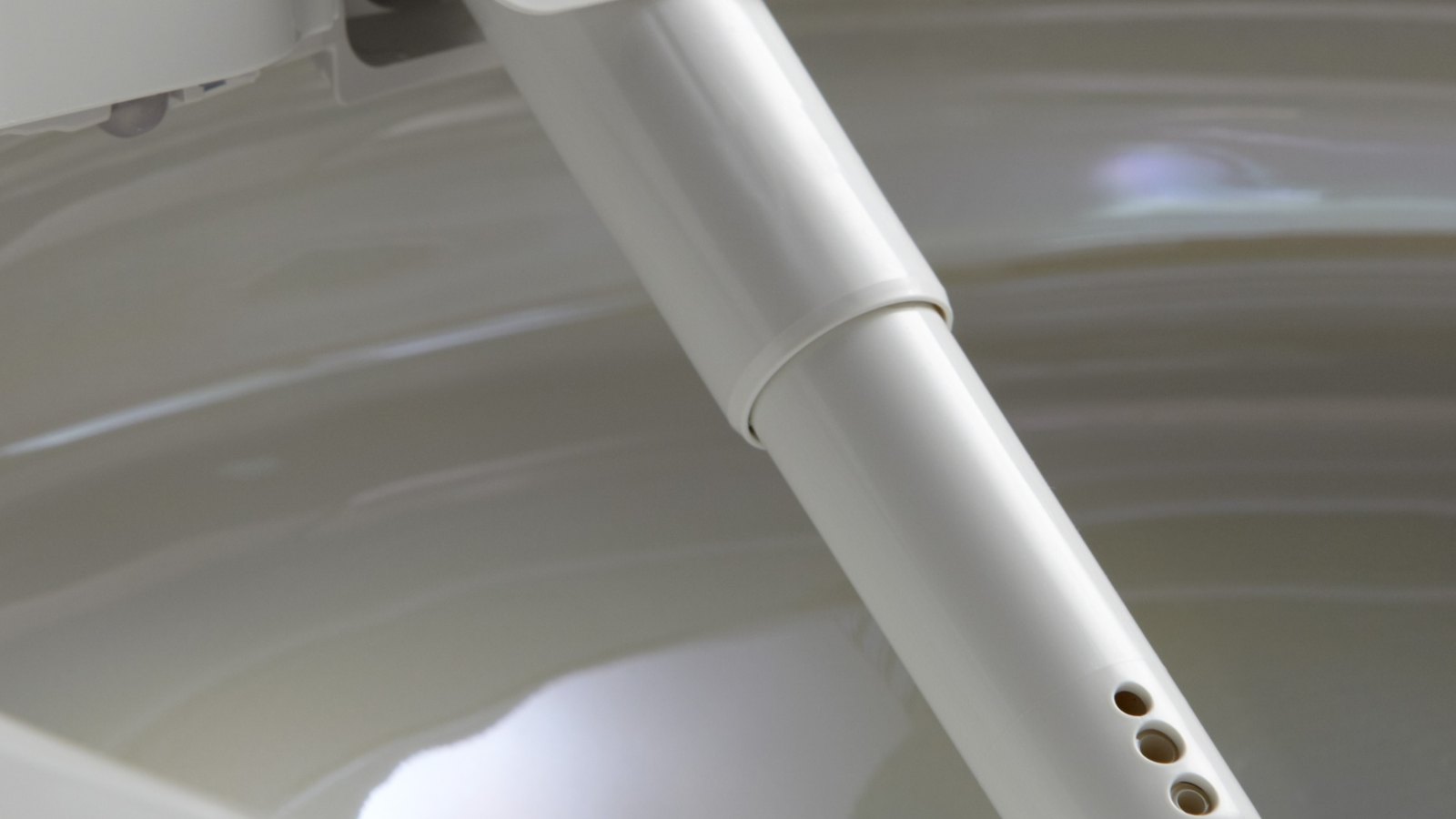
The short version: Use the seat’s nozzle-cleaning button to extend the wand, wipe it gently with a soft, damp cloth or soft toothbrush and a little mild, neutral soap, then retract it. TOTO’s C5 manual sets the wand at about once a month, alongside a daily wipe of the seat. Skip bleach, toilet bowl cleaner, solvents and scrub pads, and use vinegar only if your manual allows it.
A bidet nozzle rinses itself every time it runs, so it is easy to assume it never needs a hand. Manufacturers disagree. Their manuals still ask for a periodic manual clean, and they are specific about what to use and what to keep away from the wand. This guide pulls that guidance together from the manuals and support pages of TOTO, Brondell, Bio Bidet, Coway, Alpha Bidet, Tushy and Luxe Bidet, for both electric seats and non-electric attachments.
On this page
- What Self-Cleaning Does, and What It Leaves to You
- How Often to Clean the Nozzle
- Step by Step: Cleaning a Seat Nozzle
- Removable Nozzles, Tips and Ducts
- Mineral Buildup and Vinegar
- What Damages a Bidet Nozzle
- Cleaning an Attachment Nozzle and Guard
- The Filter and the Seat Surface
- Cleaning Schedule by Part
- A Routine for Cleaning on a Parent’s Behalf
What Self-Cleaning Does, and What It Leaves to You
Nearly every seat and attachment rinses its nozzle with water before or after a wash. Brondell’s retractable nozzles rinse before the spray starts and again when they retract. Bio Bidet’s BB-2000 rinses the nozzle before each use. Tushy’s attachments rinse the nozzle with running water before it extends, and Luxe’s Neo attachments have a Nozzle Clean setting that streams fresh water over the nozzle and its guard gate.
Some seats go further. TOTO’s EWATER+ makes electrolyzed water from ordinary tap water and mists the wand inside and out before and after every use, and TOTO says it returns to plain tap water in about two hours. The Brondell Swash 1400 has a Sterilize button that runs a 60-second cycle while the stainless steel nozzles extend and retract.
None of these brands presents self-cleaning as a replacement for wiping. TOTO describes EWATER+ as keeping surfaces cleaner between manual cleanings, and the C5 manual still lists wand cleaning as a monthly job. Luxe states directly that self-cleaning supplements wiping and does not replace it. A rinse moves loose residue; it does not lift film, mineral spots or anything dried on.
How Often to Clean the Nozzle
Only a few manuals give a number, and they vary. TOTO’s C5 manual puts the wand at about once a month. Luxe suggests wiping the nozzle and its housing weekly with mild soap and water, more often in a shared or busy bathroom. Brondell, Coway and Bio Bidet say to clean regularly without setting an interval, and Bio Bidet adds that self-cleaning electric nozzles usually need less frequent attention than manual ones.
A sensible default is a quick look each time you clean the toilet and a proper nozzle clean once a month, moving to weekly for an attachment, a household with several users, or hard water. Clean sooner whenever you can see residue on the wand.
Step by Step: Cleaning a Seat Nozzle
The key step is extending the wand with the seat’s own cleaning mode instead of pulling it out by hand. In that mode the nozzle stays out for you, often with a soft trickle of water, and the seat knows to bring it back afterward. The button name differs by brand, so find it in your manual before you start.
- TOTO C5: press Wand cleaning on the remote; press Stopping to retract.
- Brondell Swash 1400: press Nozzle Cleaning on the side panel once for the front nozzle, again for the rear nozzle, and a third time to retract.
- Bio Bidet BB-2000: with no one seated, hold Rear Wash on the side panel for 3 seconds; press Stop to retract.
- Coway Bidetmega: the button is called rinse nozzle on the 150, extract nozzle on the 200 and cleanse nozzle on the 400; press it again to retract.
With the nozzle out, the cleaning itself takes a minute or two. Work slowly and keep pressure light throughout.
- Put on gloves and set out a soft cloth, a soft toothbrush and a small bowl of warm water with a drop of mild dish soap.
- Extend the nozzle using the cleaning mode for your model.
- Wipe the wand from base to tip with the damp cloth, then work the spray holes lightly with the brush if your manual allows a brush.
- Wipe again with a cloth dampened in clean water to remove any soap.
- Retract the nozzle with the button. Do not push it back by hand.
- Run a short wash or the self-rinse to clear the spray holes.
Two cautions carry across brands. First, do not pull, push or press on the wand. TOTO warns that this can cause a malfunction, and Brondell says too much pressure can damage the nozzle system. Second, check whether your brand allows a brush. Brondell, Bio Bidet and Alpha name a soft toothbrush, while TOTO specifies a soft, wet cloth for the wand and lists nylon scrubbing brushes among items that can cause damage.
Removable Nozzles, Tips and Ducts
Some seats let you take parts of the nozzle assembly off for cleaning. Coway says the stainless steel nozzles on its cleaning bidet can be removed, and on Bidetmega models the nozzle duct and dryer duct lift out so you can wash them with water and a neutral detergent. Coway asks you to let them dry fully before reattaching, and to keep them from dropping into the bowl.
Bio Bidet’s own cleaning guidance is that if your seat has removable nozzle tips, you take the tip off, brush away particles gently and reattach it. If your manual does not show a removable tip, assume there is not one. Most of the manuals reviewed here, including TOTO’s C5, Brondell’s Swash 1400 and Alpha’s ONE, describe cleaning the nozzle in place and do not mention a detachable tip. Forcing one off is a good way to break a seal.
Mineral Buildup and Vinegar
Hard water leaves white or crusty deposits on spray holes, which can weaken or bend the spray. Vinegar dissolves them, but this is where manufacturer guidance splits, so check yours before you reach for the bottle.
Two attachment makers permit it. Tushy’s Classic 4.0 support page suggests wrapping the nozzle in a rag or paper towel soaked in white distilled vinegar for 30 minutes to a few hours. Luxe’s Neo 185 Plus manual suggests paper towels soaked in vinegar for a nozzle stuck by hard water deposits. Bio Bidet’s cleaning article mentions a 1:1 mix of water and white vinegar for wiping a nozzle.
Other makers point the other way. Brondell says to avoid full-strength vinegar, Coway says to avoid acidic or alkaline products, and the TOTO C5 and Bio Bidet BB-2000 manuals call for neutral detergent only. On those seats, stay with mild soap and a soft cloth, and call support about persistent scale. If your manual permits vinegar, rinse with plain water afterward so no acid sits on the wand.
What Damages a Bidet Nozzle
The prohibited lists overlap heavily. Bleach appears in the guidance from Brondell, Alpha, Tushy and Luxe. Paint thinner and benzene appear in the guidance from TOTO, Brondell, Bio Bidet, Alpha and Tushy. Hydrochloric acid and chloride cleaners are named by Brondell, Tushy, Alpha and Luxe, and Brondell explains that they can corrode metal parts and discolor or scratch the body.
Toilet bowl cleaner is a common cause of damage, because it splashes. TOTO and Bio Bidet both list it as prohibited, and Bio Bidet’s BB-500 manual asks you to wipe off any bowl cleaner that lands on the bidet. Abrasives are the other risk: TOTO prohibits powdered cleanser and nylon scrubbing brushes, Alpha prohibits abrasive paper and polishing agents, and Brondell warns against abrasive sponges.
Toilet paper is not as gentle as it looks. TOTO’s C5 manual lists it among materials that can damage the wand, so use a cloth. Bio Bidet also says never to spray bathroom cleaner straight onto the nozzle or seat; put it on the cloth instead. Tushy notes that bleach and harsh chemicals can damage the hoses as well as the plastic.
Cleaning an Attachment Nozzle and Guard
Non-electric attachments have no cleaning button, so the nozzle comes out by hand or by a mode on the control knob. On Luxe’s Neo models, turn the mode knob to Nozzle Clean and lift the flow lever to rinse the nozzle and guard gate, which Luxe recommends before and after each use. The guard gate should stay closed at all times, and you open it by hand only to reach the nozzle for cleaning.
Tushy’s nozzle sits in its own housing and rinses when you turn the pressure knob slightly. For a full clean, Tushy says to pull the nozzle down by hand and wipe around it with a damp cloth rather than spraying cleaner on it. Wipe the guard and housing too, since residue there drips back onto the nozzle. Our guide to bidet attachments vs. seats covers how the two designs differ.
While you are down there, look over the hoses. Tushy recommends a once-a-year check of hoses and connections and replacing hoses every 4 years, while Luxe says to inspect and replace them every 3 to 5 years. Our attachment installation guide shows how the hoses connect.
The Filter and the Seat Surface
Every seat has a small mesh strainer at the water inlet, and a clogged one weakens the spray. Brondell recommends checking the Swash 1400’s filter at least once a year, TOTO suggests cleaning the C5’s water filter drain valve about every 6 months, and Bio Bidet’s guidance is every few months. Close the shutoff valve and unplug the seat first. Our guide to low bidet water pressure walks through the strainer.
TOTO seats with a deodorizer also have a removable deodorizing filter, which TOTO asks you to brush with a toothbrush about monthly and dry fully before you reinstall it.
For the seat and lid, unplug the unit and wipe with a soft, damp cloth and mild cleaner. Brondell suggests a 1:1 mix of rubbing alcohol and water for most stains. Many seats, including TOTO and Brondell models, slide off their mounting plate with a quick-release button for cleaning the gap underneath.
Cleaning Schedule by Part
This table combines the intervals and materials from the manuals above. Where a brand gives a specific figure, it is named; your own manual overrides it.
| Part | How often | What to use | What to avoid |
|---|---|---|---|
| Seat nozzle (wand) | About monthly (TOTO), sooner if residue shows | Cleaning mode to extend it, soft damp cloth, soft toothbrush where allowed, mild neutral soap | Pulling or pushing the wand, toilet paper, scrub pads, nylon brushes |
| Attachment nozzle and guard | Weekly wipe (Luxe); rinse mode before and after use | Damp cloth with mild, pH-neutral soap | Spraying cleaner directly on it, bleach, hydrochloric acid |
| Removable nozzle, tip or duct | When cleaning the nozzle, if your model has one | Water and neutral detergent, soft brush; dry fully before refitting | Forcing off parts the manual does not show as removable |
| Mineral scale on the nozzle | As needed in hard water | Vinegar wrap only where permitted (Tushy, Luxe); otherwise mild soap | Vinegar on seats whose manuals require neutral detergent only |
| Seat and lid | Daily wipe (TOTO) | Soft damp cloth, mild cleaner; 1:1 rubbing alcohol and water for stains (Brondell) | Toilet bowl cleaner splashes, bleach, thinner, benzene, abrasives |
| Inlet strainer or filter | Every 6 months (TOTO) to at least yearly (Brondell) | Toothbrush under running water, with water off and seat unplugged | Removing it with the shutoff valve open |
| Deodorizer filter (TOTO) | About monthly | Toothbrush; dry completely before refitting | Reinstalling it wet |
| Attachment hoses | Check yearly; replace every 3 to 5 years | Visual check for wear, kinks or drips | Bleach and harsh chemicals on the hoses |
A Routine for Cleaning on a Parent’s Behalf
If you look after a parent’s bathroom, nozzle cleaning is a good job to take off their list. It involves bending over the bowl and fine button work, and the parts are small. A simple routine fits into a regular visit and keeps the seat in good shape between calls.
Keep a small kit in the bathroom: gloves, two soft cloths, a soft toothbrush and a bottle of mild dish soap, labeled so no one swaps in bathroom spray. On each visit, wipe the seat and lid and look at the nozzle. Once a month, run the nozzle-cleaning mode and do the full clean above. Put the strainer check on the calendar at the interval your manual gives.
A few habits help. Ask whoever cleans the toilet to wipe away any bowl cleaner that splashes onto the seat. Note the date of each nozzle and filter clean on the inside of a cabinet door so others who help can keep it going. If a home aide cleans the bathroom, show them the cleaning button and the cleaners to avoid. Our bidet caregiver guide covers setup and shared care.
When Cleaning Doesn’t Fix It
If the nozzle still sprays crooked, stays out or won’t come back after cleaning, the problem is probably not dirt. Our guide to a bidet nozzle not retracting covers the next checks. TOTO’s C5 manual also notes that when its Wand CLEAN light no longer comes on, the part that makes EWATER+ is due for replacement, which is a call to TOTO support. Model specifics are in our TOTO Washlet C5, Brondell Swash 1400 and Bio Bidet BB-2000 reviews.
Image credit, cropped: photo by Robert Basic from Germany, Wikimedia Commons, CC BY-SA 2.0.