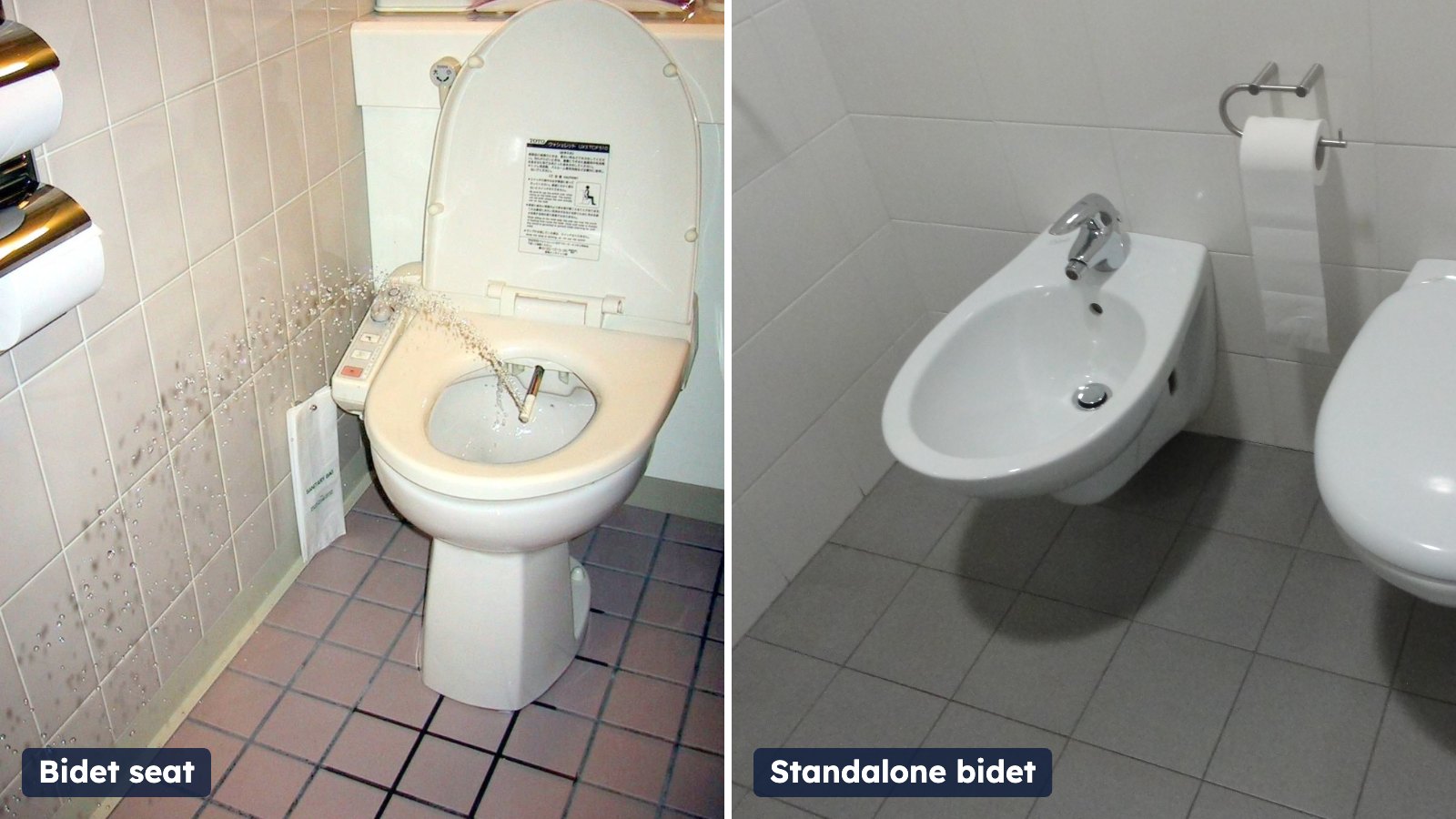
The short version: For most homes, and for nearly everyone with limited mobility, a bidet seat is the better fit. It uses your existing toilet and cold water line. A porcelain standalone bidet needs about 60 inches of wall to sit beside the toilet, hot and cold supply, a drain, and a vent, plus a move to a second, lower fixture.
A standalone bidet and a bidet seat do the same basic job, but they ask very different things of your bathroom. One is a second plumbing fixture with its own floor space, supply lines, and drain. The other replaces the seat on the toilet you already own.
If you are new to the categories, start with What Is a Bidet? If you are choosing between two toilet-mounted options, see Bidet Attachment or Seat? This page answers one question: should a homeowner put a seat on the existing toilet, or add a separate porcelain fixture?
What a Standalone Bidet Is
A standalone bidet is a low, basin-like bathroom fixture that provides a stream of water for washing. The models from Kohler, TOTO, and American Standard are vitreous china bowls fastened to the floor, each fitted with a deck-mounted bidet faucet. It sits beside the toilet and does not replace it.
The routine has more steps than people expect. You finish at the toilet, stand up and move across to the bidet, then straddle the bowl or sit on its rim to wash. You can face either way. Afterward, you dry off, often with toilet paper.
A bidet seat removes that middle step. The wash happens where you are already sitting, and seats like the Brondell Swash 1400 add a warm air dryer. That one difference, staying put versus moving, drives most of what follows.
Floor Space and Code Clearances
Start with the fixture itself. Manufacturer listings put these bowls at a little over 2 feet long, about 15 inches wide, and about 15 inches tall. American Standard’s spec sheet gives slightly different nominal figures for the Cadet than its product page does, so confirm the numbers for the exact model you are considering. TOTO marks all three of its bowls as limited inventory, so check availability too.
| Model | Length | Width | Height |
|---|---|---|---|
| TOTO Lloyd BT930B | 25-1/2 in | 14-1/8 in | 15 in |
| TOTO Clayton BT784B | 25-1/2 in | 14-1/8 in | 15 in |
| TOTO Pacifica BT904A | 26-3/8 in | 15 in | 15 in |
| American Standard Cadet | 25-3/4 in | 15 in | 14-1/2 in |
The Space Around It
The bigger issue is the space around it. Plumbing codes treat a bidet the way they treat a toilet, with a minimum distance from its centerline to anything beside it and clear floor in front. The two model codes agree on side spacing and differ on front clearance.
| Minimum Clearance | International Plumbing Code (2018) | Uniform Plumbing Code Text (California 2025) |
|---|---|---|
| Center to side wall or obstruction | 15 in | 15 in |
| Center to center, adjacent fixtures | 30 in | 30 in, to a similar fixture |
| Clear space in front | 21 in | 24 in |
What That Means on the Floor
Here is what that means on the floor, by our own arithmetic. A toilet and bidet side by side along one wall need at least 60 inches of wall: 15 inches, plus 30, plus 15. Front to back, a bidet needs about 46-1/2 to 50-3/8 inches from the wall, adding the listed length to the front clearance.
Some models need more. Kohler’s San Tropez sheet calls for a 6-inch dimension to allow for drain and supply connections from the rear of the bidet. And a toilet compartment built to the International Plumbing Code minimum of 30 inches wide has no spare width, since the toilet’s 15 inches per side uses all of it.
A published summary of the 2024 International Residential Code gives the same 15, 30, and 21 inches, and local amendments can change any of these numbers. A seat, by contrast, takes no new floor space. It only needs to fit the toilet, which you can check with Will a Bidet Fit My Toilet?
What the Rough-In Plumbing Involves
A bidet seat borrows what the toilet already has. A TOTO WASHLET installation guide has you connect to the cold supply only, through a supplied junction valve at the tank’s water inlet. Bio Bidet and Brondell both describe their seats as installable without a plumber. Electric seats do need a grounded GFCI outlet nearby, which Do You Need an Outlet? covers.
What a Standalone Bidet Needs
A standalone bidet needs a full set of its own connections. Kohler’s installation guides call for hot and cold supplies with 3/8-inch shutoff valves, plus a drain outlet. TOTO and American Standard list a 1-1/4-inch outside diameter waste, and American Standard notes that the P-trap is ordered separately and that floor provisions must be made for it.
Drain and Supply Routing
Routing varies by model. Kohler’s San Tropez sheet allows the trap above or below the floor and supplies from the floor or the wall, while Kohler’s 2002 guide for the K-4858 says the drain must exit through the floor with the trap below it. The American Standard Cadet page describes a through-the-floor outlet.
Venting
The vent is the item people miss, because the spec sheets we read leave it out. California’s plumbing code says that no trap shall be installed without a vent, except as the code otherwise provides. A bidet has a trap, so the drain line has to tie into a vented system. Published tables list a minimum 1-1/4-inch trap for a bidet.
What It Means for a Finished Bathroom
Add those up in a finished bathroom with no lines at that spot, and you are often looking at opening a wall, a floor, or both. That is our reading of the requirements rather than a line from a manual, and a licensed plumber who has seen your bathroom can tell you how far it goes. It is why a standalone bidet tends to belong in a larger remodel.
Backflow Protection and Water Temperature
Two code items apply to a fixture with a hot supply and a spray in the bowl. The first is backflow. California’s code, section 410.2, requires the supply to be protected by an air gap or by an atmospheric, pressure, or spill-resistant vacuum breaker. A vacuum breaker’s purpose is to stop back siphonage and protect the water supply.
Kohler’s K-4854 is drilled for a fixture-mounted vacuum breaker, TOTO’s BT930B is designed for a deck-mounted faucet with diverter and vacuum breaker, and American Standard’s Cadet drawing shows one. Kohler’s San Tropez also requires a faucet with a transfer valve or diverter, so buy the bowl and faucet as a matched pair.
The second is temperature. California’s code caps bidet discharge at 110°F, using a limiting device or water heater that meets named standards, and New York City’s code sets the same 110°F limit with a limiting device. An electric seat sidesteps the hot line entirely: TOTO’s WASHLET connects to cold water, and heating happens in the seat.
What Each Option Costs
Prices change, so treat these as rough figures at the time of writing. Kohler lists the San Tropez bowl at $732.07 and the Memoirs bowl at $791.92. American Standard’s Canadian site shows a list price of $844 for the Cadet bowl, with the white version marked sold out or unavailable. TOTO’s spec sheets do not state prices. The faucet is extra: TOTO sells it separately, and American Standard does not include it.
Faucets are not a small line item. Kohler lists its Purist vertical spray faucet at $1,187.17, and the price filter on Kohler’s bidet and faucet category, which also covers the bowls, runs from $600 up to $2,100. For a sense of scale, by our own arithmetic, either Kohler bowl plus a faucet at that price comes to roughly $1,920 to $1,980 before trap, valves, temperature device, or plumbing labor. Ask Kohler which faucet suits your bowl.
Labor depends on how far the new lines must run, so get a written quote that includes wall and floor repair. For seats, Brondell lists the Swash 1400 at $479.99 to $495.99 on sale, down from $599.99 to $619.99, and Bio Bidet lists the BB-2000 at $489. See What a Bidet Actually Costs, Installed for the fuller picture.
Why Accessibility Favors a Seat
This is where the choice stops being about plumbing. Moving around the toilet is already a known risk point for older adults. In a CDC report on 2008 emergency department data, getting up from, sitting down on, or using the toilet accounted for 19% to 37% of bathroom injuries among people 65 and older, against about 14% across everyone 15 and older.
Height
A standalone bidet adds a second sit-down and a second stand-up, on a low fixture. The listed heights above are 14-1/2 to 15 inches. The ADA Standards set toilet seats at 17 to 19 inches, while permitting 15 to 19 in residential dwelling units. Their toilet section does not mention bidets, so that comparison is ours, not a rule.
Height matters for standing up. MedlinePlus, the National Library of Medicine’s health site, says raising the toilet seat height can help prevent falls. A small 1996 study comparing adults aged 61 to 79 with younger adults found the older group began changing how they moved at the lowest chair heights. Neither addresses standalone bidets, though the same MedlinePlus page suggests a special seat it calls a portable bidet.
Support
Support matters too. A Georgia Tech analysis of 22 adults aged 50 and older, whose mobility impairments began before age 50, found that those who had installed at least one grab bar reported lower levels of difficulty with toilet transfers. Only 16 of them did toilet transfers, the paper gives no significance test, and the authors called it exploratory.
With two fixtures, you would need to think about support at both, and at the steps between. California’s code does not count accessibility grab bars as obstructions.
Straddling and Our Judgment
Straddling is its own ask. Getting a leg over a low bowl, lowering down, and reaching for deck-mounted handles all call on balance and hip movement, and some people will find it easier than others. We should be clear about the line here: the studies above do not compare a seat with a standalone bidet directly, so our conclusion is judgment, reasoned from the figures.
That judgment is simple: if transfers, balance, or leg strength are a concern, one fixture beats two. A seat keeps you in one position, on a toilet that can have grab bars beside it. For caregivers, a 2021 feasibility study in The American Journal of Occupational Therapy, with ten informal caregivers, reported that all of them said an automated bidet made toileting easier. See our limited mobility and caregiver guides.
Bidet Seat vs Standalone Bidet at a Glance
This table pulls the figures above into one place. The space numbers are minimums worked out from code text, and the prices are rough figures at the time of writing, for the models named earlier.
| Factor | Bidet Seat | Standalone Bidet |
|---|---|---|
| New floor space | None | About 60 in of wall for toilet and bidet side by side |
| Water supply | Cold, from the toilet’s supply line; dual-temperature non-electric seats also tap a sink’s hot line | New hot and cold lines with shutoffs |
| Drain and vent | Uses the toilet’s | Own trap and drain, tied into a vented system |
| Electrical | Grounded GFCI outlet for electric models | None listed on the spec sheets |
| Backflow and temperature | Follow the seat manual | Vacuum breaker or air gap, plus a 110°F limit |
| Hardware cost | About $480 to $620 | About $730 to $790 for a Kohler bowl, plus a separate faucet |
| Daily routine | Stay seated on the toilet | Move to a second fixture and straddle it |
| Height | About your toilet’s height, sometimes a little higher | About 14-1/2 to 15-1/2 in |
| Installer | Often DIY, per manufacturers | Likely a plumber, given the new lines |
Who Should Pick Which
Pick a bidet seat if you want a wash without a renovation, which covers most readers. It is the clear choice if anyone in the home has trouble with reach, grip, balance, or standing up, or if a caregiver helps with toileting. It also suits buyers over 60 planning to stay in the home. Good starting points are the Brondell Swash 1400, the Bio Bidet BB-2000, and the TOTO Washlet S2, a lower-priced seat with a side panel. The TOTO Washlet S5 adds a remote.
Pick a standalone bidet if three things are all true: you are already remodeling, so walls or floors will be open anyway; the room has the space to clear the numbers above; and everyone using it can move between fixtures and straddle a low bowl comfortably, now and for the years you plan to stay.
If you are unsure, the seat is the easier decision to reverse. It leaves your plumbing and floor plan as they are. Either route gets you a bidet, and we think every home should have one.
Image credits, cropped and placed side by side: bidet seat photo by Chris 73, Wikimedia Commons, CC BY-SA 3.0; standalone bidet photo by Mattes, Wikimedia Commons, public domain.